Please don't rush: slow changes in Laos 50 years after communist victory / Photo: Beatrice Siviero - AFP
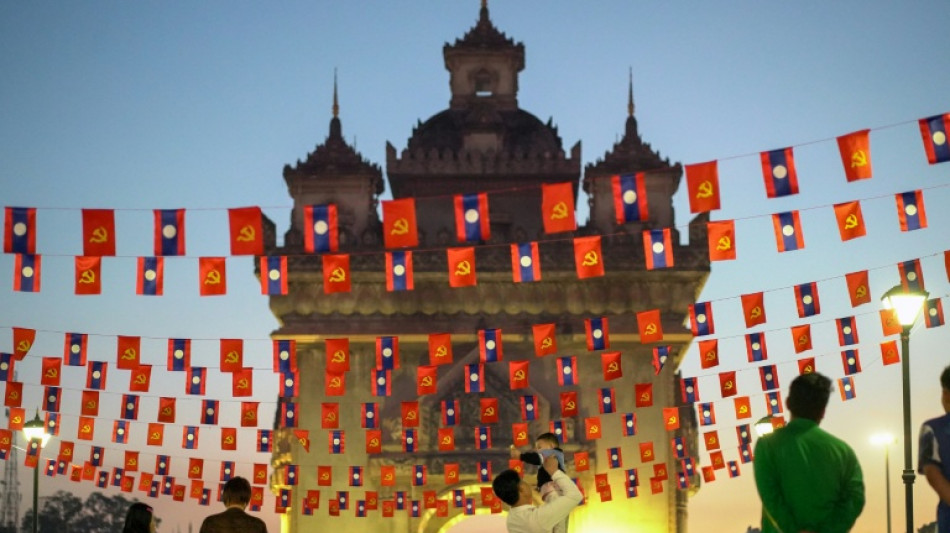
The usually sleepy Laotian capital Vientiane has an uncharacteristic buzz, bedecked with flags and T-shirt vendors ahead of commemorations of 50 years of communist rule Tuesday, but for many young people history carries little weight.
The communist Pathet Lao established the Lao People's Democratic Republic (Lao PDR) on December 2, 1975, following a decades-long civil war, months after another US-backed regime was defeated in South Vietnam -- a conflict which saw Laos devastated by American bombing.
The former French colony became a one-party communist state, King Savang Vatthana died in captivity, and centralised planning was imposed on the economy as landlocked Laos, always remote, became increasingly isolated.
It later opened up and embraced market reforms, but remains among Asia's poorer countries.
Thousands of troops and state personnel will take part in a military parade Tuesday to mark the anniversary, in keeping with other key dates in September in ideologically-aligned neighbours China and Vietnam.
But the past does not resonate with many young Laotians.
"Of course, we do learn history in school, but we don't talk about it much," said Thiradeth Khamhoung, 19, an economics student in Thailand who co-founded PrepPath, a platform helping Laotian high school students explore careers and plan their futures.
"We don't let political circumstances get in our way when we're building something," he told AFP.
"My suggestion for many youth would be just start it, don't let politics, which we can't control, hold you back."
Politics are a sensitive topic in Laos and open criticism of government policies or leaders is rare, with some youth preferring to remain anonymous to avoid any risk of repercussions.
People joke that the abbreviation Lao PDR means "Lao Please Don't Rush".
But Bart insists: "Please don't rush doesn't mean we can't develop. It's about finding our strengths, working on what we're good at, and building from there.
"Laos will change in the next 50 years just as it has since its independence: slowly, but steadily."
- TikTok window -
Social media is one of the drivers of change, he added -- even affecting language.
"Some of the words my grandpa used were in French, and I didn't even know what he was talking about," he said.
"Now, a lot of those French words are being replaced by Thai words. Media and social media are a big reason for that."
Tony, a 21-year-old university student in Vientiane, said many young people get their fashion trends, ideas and global outlook from TikTok.
"It's like a window to the world," he said.
Migration to Thailand for work is commonplace, and thousands of Laotian students head overseas each year, drawn by international education and better job prospects.
"Compared to my grandparents, it's easy for us now," said one Laotian master's student in Australia. "You just go on Google, and you can learn what you want.
"In the next 10 or 20 years, people will be speaking up more and have more freedoms."
- Trump tariffs -
China is Laos' dominant economic partner through infrastructure investments including a railway linking Vientiane and Kunming, in Yunnan province, and a wider economic corridor.
In recent years, hydropower exports have been a key economic driver, while garment factories, electronics assemblers and other light-manufacturing firms have relied on the American market.
But expansion is slowing and inflation rising while GDP per capita remains around $2,100 according to the World Bank's most recent figures and it now faces Trump tariffs of 40 percent, one of the highest rates in the world.
Those pressures mean the mindset of the younger generation is changing, "especially when comparing my grandparents' political and economic views to my own", said communications officer Namfon Sirithirath, 30.
"It's good that youth engagement is currently being promoted," she said.
"It would be much better if it were promoted more, and if policymakers listened more to their concerns or issues, so that in the future, policies could be put in place that are more appropriate for the current era."
G.Scerri--JdM