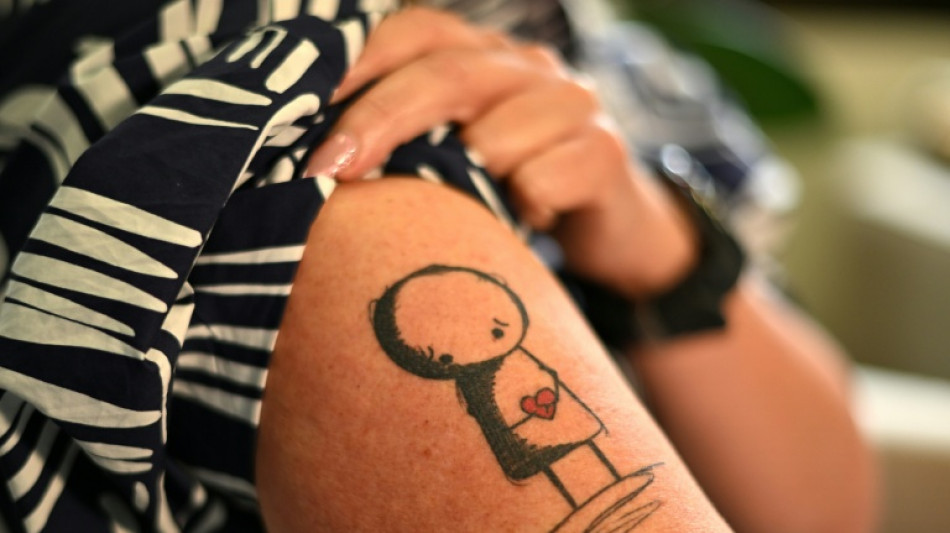
'For him': Australia mum channels grief into social media limits / Photo: Saeed KHAN - AFP
Mia Bannister's skin is inked with a eulogy to her teenage son Ollie, whose suicide after a battle with anorexia and online bullying pushed her to fight for world-first laws in Australia to get children off social media.
From December 10, under-16s in Australia will be banned from social media sites like Facebook, Instagram, Reddit and TikTok.
Companies risk hefty fines of up to $32 million if they fail to keep children off their platforms.
Were that legislation in place a year ago, Mia said, Ollie might still be alive.
"He was my best friend," she told AFP as she looked at the black inked outline of a mother holding a red cracked heart.
"He was my world."
Ollie was bullied online and apps like Tiktok, Snapchat and Youtube showed him a stream of content that fuelled his eating disorder.
She vividly remembers his mop of red curls, his quick wit and the spark in his eyes that grew duller as he got sicker.
When Ollie first got sick, he turned to social media.
But Mia said she had no idea the impact that it could have.
"I was a single parent, working full time, trying to keep a roof over our heads, not really understanding either what platforms he's on and how they work," she said.
Mia places the blame on the social media giants.
"It is their platforms and the unfiltered, unchecked content."
When parents hand their child a phone, she said, "we hand them the greatest weapon we could hand them".
- Blanket ban -
About 97 percent of teens surveyed by Mission Australia said they used social media daily, with nearly half spending three or more hours online.
Those who used social media less than three hours reported better well-being and social connection, found the poll of more than ten thousand people aged between 15 and 19.
The Australian government hopes its law will change the way children spend their time online, not kick them off the net altogether.
But major questions remain on how it will be enforced -- including how platforms will verify users' ages.
Tech companies have been critical of the plans, describing them as too vague.
So far, 10 platforms will not be banned -- including Discord, Pinterest, Roblox, LEGO Play and WhatsApp -- but Australian authorities have reserved the right to force all platforms to comply.
But some experts fear the legislation will exclude young people from opportunities and hinder the development of digital literacy skills.
"I don't think that this is the right approach to online safety," Catherine Page Jeffery, University of Sydney Media and Communications lecturer, told AFP.
"We know blanket bans don't often work."
Children may seek out unsafe online spaces instead, she warned.
"Rather than banning young people, I would prefer to see greater safety obligations placed on platforms -- and we are beginning to see more of this," she said.
"A lot of these platforms, and even the internet more broadly, have not been built for children."
- Valuable skills -
For many young people, social media can be key to forming their identity and developing valuable skills.
Ava Chanel Jones, 12, uses Instagram to document her cheering, dancing, modelling and brand promotions -- a hobby that started during the pandemic with the help of her mother, Zoe.
Her following has ballooned to more than 11,400 people, enough for a monthly income from Meta, free products from brands and to even launch her own clothing line.
Ava uses the platform to communicate with friends but not with people she does not know -- those messages go into a hidden folder monitored by her mum.
"I'm her parent -- it's my responsibility to protect her the best that I can when she's on social media," Zoe said.
"I am proud of her," she said.
"I think it's giving her skills."
From December 10, Ava may be unable to access her own account, although different platforms may have different options for how influencer accounts can be managed.
Zoe has changed some of the account's settings in the hopes they can keep it going.
Like many people, she's confused about how the legislation will be rolled out and monitored.
And she worries that it is taking away an avenue for children to pick up new hobbies or passions.
Australia's eSafety Commissioner Julie Inman Grant is adamant that the age restrictions are a "really potent solution" in stopping online harm, but admits there is no quick fix.
Grieving mum Mia misses her son every day.
She channels her pain into sharing Ollie's story through her charity, which raises awareness about eating disorders in boys and how the social media legislation will work.
"I do it for him, and I do it for all the other children out there: the lost children and the ones that we're all going to save," she said.
M.Scicluna--JdM